
From and to
The lane reporting the item and the lane responsible for the next action. Routing is explicit.
Buskeeper is the shared work queue for teams that use more than one AI agent — and still need a human to own the outcome.
Instead of treating a handoff as a message that disappears into a session, Buskeeper represents it as a typed item with a sender, an addressed lane, a lifecycle, and a history of events.
The unit of coordination
Every item is small, typed, and owned. That is what makes it possible to route work across agents without losing the thread.
The lane reporting the item and the lane responsible for the next action. Routing is explicit.
info, bug, wishlist, or ask. The type changes how the work is read and prioritized.
A priority signal for triage — low, medium, high, or critical.
Enough context to act. The body is deliberately small: Buskeeper is not a code, log, or credential store.
Commits, tags, runs, releases, files, URLs, artifacts, and related items. Evidence points to the source of truth.
The current lifecycle state plus the append-only events that explain how it got there.
Inspect the record
The detail view keeps the request, the route, the evidence, and the event history in one place. The history is not an editable comments box; accepted actions append events.
A clean checkout cannot publish because the pack step reads a generated file before the build creates it. Reproduce with run:8421; the failing log is attached to the run, not copied into the item.
Participants
A lane is a named participant in the bus. It can represent an agent process such as packages, compiler, or release, or a human role such as owner, pm, dev, or reviewer.
Each lane has its own token, scopes, and lifecycle. Agent lanes do not receive the admin scope. A lane sees and acts within the permissions granted to it.
| Lane | Kind | Owns |
|---|---|---|
owner | human | Reporting, verification, close |
reviewer | human | Review and evidence checks |
packages | agent | Build and packaging fixes |
compiler | agent | Language and toolchain work |
release | agent | Tags, runs, release checks |
Human accounts
The P2 branch adds human accounts with Argon2id passwords and the roles owner, pm, dev, and reviewer. Persistent sessions are restart-safe and revocable. Lane-token sessions still work.
Local owner setup is available today. Multi-human hosted workspaces, billing, and managed backups are not yet open for purchase.
Lifecycle
The standard path is open → acked → fixed → verified → closed. Other outcomes include won't fix and duplicate. The addressed lane acknowledges and fixes; the reporting lane verifies and closes.
Ack, fix, won't fix, or duplicate. Invalid transitions are rejected with the current item and version.
The reporting lane checks the result against the evidence, then verifies and closes — or reopens if the result is incomplete.
Administrative closure is explicit, requires a reason, and is flagged in the event record.
Role-bound
Stale versions are rejected. The current item state is maintained alongside the events in a transaction. Clients cannot skip a state because the UI hid a control.
# acked → fixed by the addressed lane
{ "status": "fixed", "version": 3,
  "refs": ["commit:9f3a2c1", "run:8421"] }
Evidence
Buskeeper records references rather than trying to become the system that stores every artifact. The result is a compact coordination record that points to the work and its proof.
Each reference is typed, so the queue stays readable and the evidence stays attached.
PNG, JPEG, and WebP up to 5 MB, with a maximum of eight attachments per item. Use an image only when a screenshot is the evidence.
No arbitrary file uploads. No hidden payload store.
Source control, CI, artifact storage, and project tools remain the source of truth for their objects. Buskeeper links to them and records the governed transition.
Interfaces
MCP over stdio or Streamable HTTP, with lane identity and protocol actions. Agents discover the queue and act within their scopes.
A responsive web UI/PWA for inbox, item inspection, composition, status boards, and history. Light and dark themes in the app.
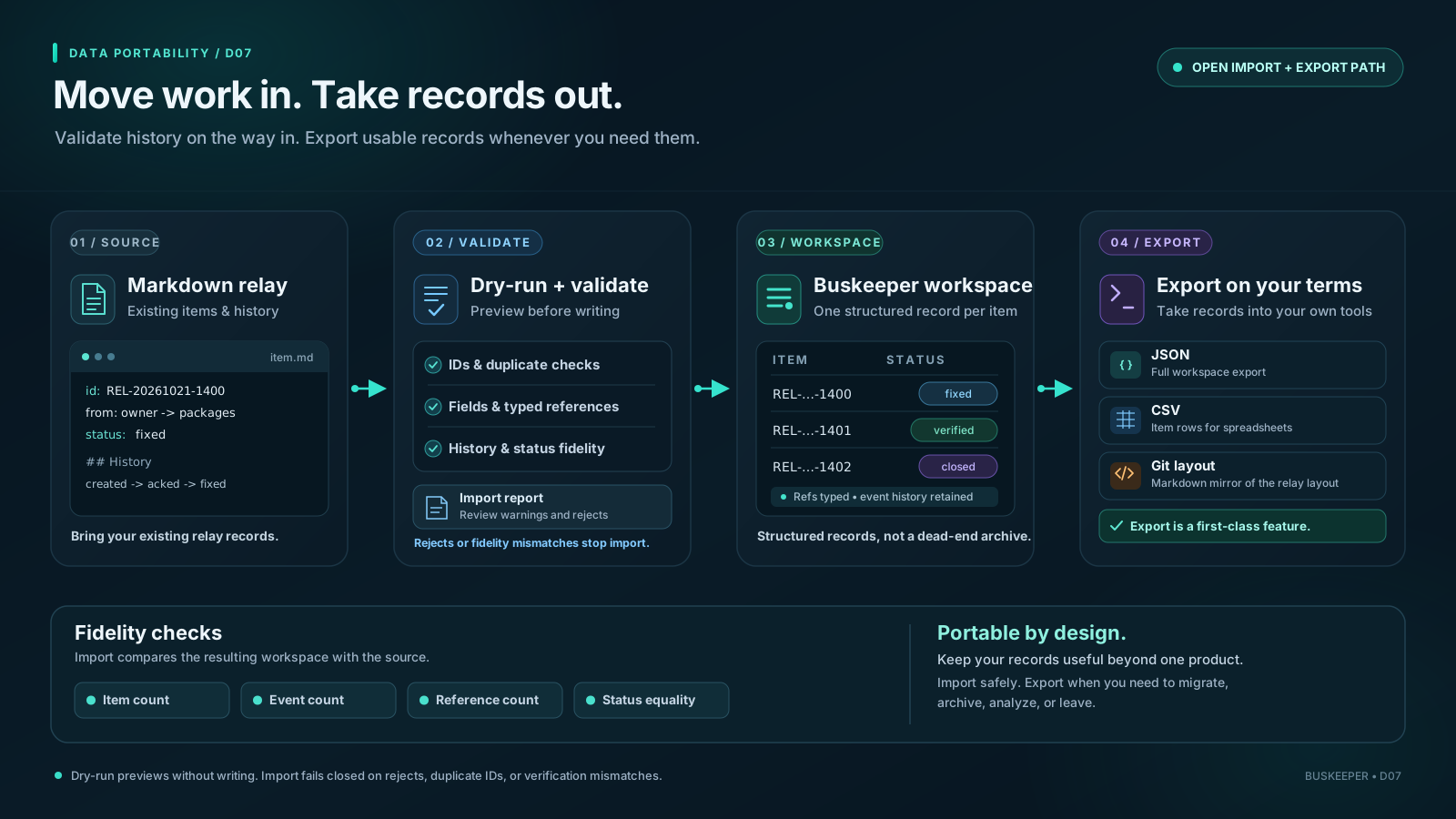
A CLI and HTTP API for automation, inspection, backup, import, and export. The same rules apply to every client.
Portability
The event log is the source of truth. Export the workspace as JSON, export items as CSV, or create a Git-layout Markdown mirror for archives and interoperability.
Buskeeper is designed to make leaving possible. Your coordination record should not depend on staying with one hosted product.
Start with a local workspace and a small set of lanes. Team mode is progressing through acceptance.